Biography
of Friedensreich Hundertwasser
Born in Vienna, Austria in 1928, Hundertwasser
entered the Vienna Academy of Art in 1948, but only stayed
for three months. The following year he left Vienna and
began his wanderings.
In 1958, he published his Verchimelungsmaifest gegen den
Rationalismus in der Architektur, in which he expressed
a fundamental distrust of modern architecture and argued
for a more ecological approach.
In 1961, he visited Japan for the first time, on the occasion
of a solo exhibition of his work. While in Japan, he painted
pictures in Tokyo, Nara and Hokkaido. Also, having already
had an interest in Hiroshige and Hokusai, Hundertwasser
attempted to make woodblock prints with some Japanese
printmakers.
Hundertwasser was also known for his production of advertisements
for stamps, posters and other items that were designed
to make statements about environmental problems. He also
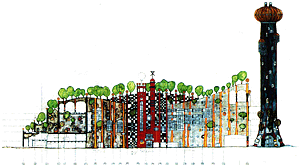
produced many model houses to serve as examples of our
ability to coexist with nature. Hundertwasser is widely
recognized as one of the most famous practitioners of
"ecological art."
In February 2000, he died of heart failure while on-board
a ship sailing from New Zealand to Europe. |
|
 |
|
|
 |


